Mastering the 8-Part ChatGPT Prompt Structure
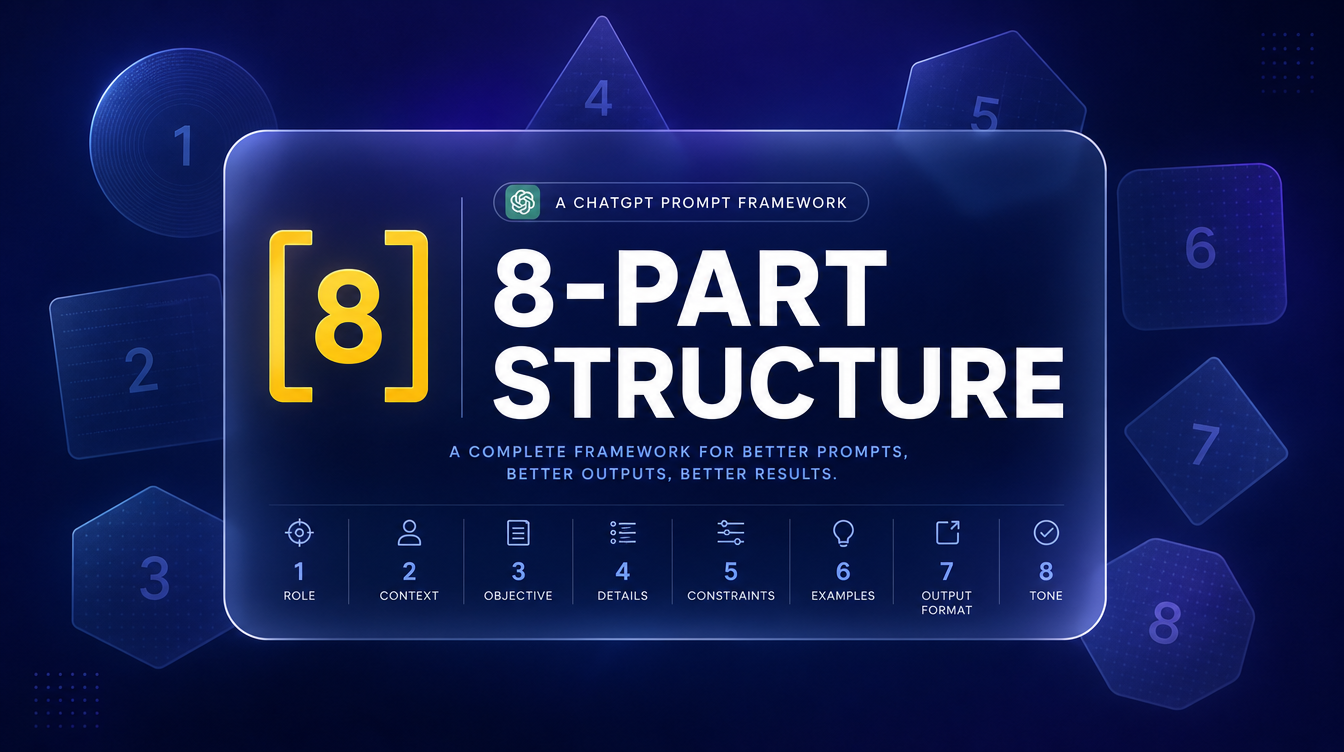
Most prompt frameworks stop at three or four components. Role, task, context. Or goal, format, tone. These are useful starting points. But if you're doing serious work with ChatGPT — client deliverables, content at scale, complex analysis — they leave too much unspecified. The gaps fill with defaults, and defaults produce average outputs.
The 8-part structure I use covers everything a model needs to produce professional-quality output reliably. Not every prompt needs all 8 parts. But when output quality matters and you're not getting what you need, one of these 8 is almost always what's missing.
The Complete 8-Part Framework
Here are the eight components, in the order they should appear in most prompts:
Part 1: Role
Who ChatGPT should be for this task. Not a general title but a specialized identity with a specific track record and perspective: "a DTC copywriter who has worked with 40 Shopify brands and specializes in conversion-optimized product pages" rather than "a copywriter."
The role creates a filter before the model writes a single word. It shapes vocabulary assumptions, the implicit standards the output is held to, and the perspective used to make judgment calls throughout the response.
Part 2: Audience
Who the output is for. Defining your audience is separate from defining your goal because the model needs to calibrate differently for different readers. A technical explanation for engineers reads nothing like an explanation for non-technical executives. A sales email for skeptical procurement managers reads nothing like one for excited early adopters.
Include: role or identity, knowledge level, their primary concern about the topic, and anything they already believe that the output needs to work with (or against).
Part 3: Goal
What you want the output to accomplish. This is the outcome, not the deliverable. "I want to persuade the reader to book a demo" is a goal. "Write an email" is a task. Goals shape the entire output — they tell the model what success looks like, which changes which arguments to lead with, which objections to address, and how to close.
Part 4: Task
What you want produced. The deliverable, with enough specificity to eliminate structural ambiguity: format, length, required sections, any elements that must appear. "Write a 200-word product description with a hook in the first sentence, 3 benefit bullets, and a CTA" is a task. "Write a product description" is not.
Part 5: Context
Everything the model needs to know to make good decisions. Your brand, your product, relevant background about the situation, constraints from the real world that will affect what works. This is the component most people underspecify. When an output feels generic, it's usually because the context section was either missing or too thin.
Context isn't just background information — it's the specific details that make your situation different from the average case the model was trained on. What makes your product or argument unusual? What does the audience already know or believe? What has already been tried?
Part 6: Format
What the output should look like structurally. This goes beyond "write a list" or "write a paragraph." For complex outputs, specify the exact structure: section headings, what each section contains, the order they appear in, and how the piece should begin and end.
Format specification is particularly important for structured deliverables: landing page copy, email sequences, reports, scripts, data tables. Without a format spec, the model uses defaults that may not match your needs.
Part 7: Constraints
What to avoid. This is a separate component because it works differently from positive instructions. Constraints narrow the output range by eliminating failure modes you've seen before or can predict.
Effective constraints are specific: not "be concise" (subjective) but "no sentence over 20 words" (measurable). Not "avoid jargon" but "avoid the following specific terms: [list]". The more precise the constraint, the more reliably it's followed.
Constraints can also cover structure ("don't use subheadings"), content ("don't make claims about [specific topic] without citing evidence"), and tone ("don't use hedging language like 'it's important to note' or 'it seems'").
Part 8: Examples
Reference material for quality and style. This is the most powerful component people consistently skip. Examples calibrate the model's output more precisely than any adjective can. "Professional but warm, like Patagonia's website copy" is an example reference. "Write like this: [paste a sample]" is even more powerful.
Examples don't have to be perfect matches to your situation. They just need to demonstrate the quality level, style, or structural pattern you're aiming for. One good example is worth more than three paragraphs of style description.
The Master Template
That's the full template. For shorter, simpler tasks, collapse it: use only the components that matter for that specific output. For a quick email rewrite, you might only need role, task, and a constraint or two. For a high-stakes sales page or a complex analysis, all eight earn their place.
How to Use the Framework Efficiently
The 8-part structure isn't meant to be filled in from scratch every time. The goal is to save working templates for the tasks you repeat most. Once you have a template for product descriptions, email rewrites, or SEO outlines, each new version takes minutes to fill in — not the 15-20 minutes it takes to construct a prompt from first principles.
My recommendation: identify your five most common ChatGPT tasks. Build a full 8-part prompt for each one. Save them with placeholder brackets for the variables that change each time. Those five templates will cover the majority of your AI workflow, and every output they produce will be noticeably better than what you'd get from ad hoc prompting.
Where Single-Component Failures Show Up
When a prompt isn't working, the fix is almost always in one specific component. Here's the pattern I see most often:
Output too generic — Context (Part 5) is thin. Add more specific details about your situation, product, or audience's existing beliefs.
Wrong tone — Role (Part 1) is too broad, or Examples (Part 8) are missing. Either specify the role more precisely or paste in a style sample.
Wrong structure — Format (Part 6) wasn't specified. Add explicit structural instructions: sections, order, opening and closing patterns.
Unwanted content appearing — Constraints (Part 7) didn't cover it. Add a specific "do not" instruction for whatever keeps showing up.
Missing the point — Goal (Part 3) was implicit, not stated. Make the outcome explicit: what should happen in the reader's mind after they encounter this output?
That template turns debugging into a systematic process instead of trial and error.
Frequently Asked Questions
Do I always need all 8 parts?
No. Simple, one-off tasks may only need three or four components. The value of knowing all 8 is that you know which components to reach for when you're not getting what you want. Think of them as the full diagnostic checklist rather than a mandatory form to complete every time.
Does the order of the 8 parts matter?
The order in the template above is generally effective, but it's not rigid. What does matter is that Role appears early (it sets context for everything that follows), and Constraints typically work better near the end (they function as guardrails on the content established by the earlier components). The middle components can be rearranged based on what's most important for your specific prompt.
How is this different from other prompt frameworks I've seen?
Most public frameworks prioritize simplicity over completeness — they're designed to be memorable, not comprehensive. The 8-part structure is designed for professional use cases where output quality matters and defaults aren't good enough. It covers Audience and Goal as separate components (usually collapsed or omitted in simpler frameworks), and treats Constraints and Examples as first-class components rather than optional additions.
How long should a complete 8-part prompt be?
For most professional tasks, a complete 8-part prompt runs 100-250 words. Complex technical prompts can be longer. There's no penalty for length as long as each component adds real information. What hurts quality is word count that adds vagueness rather than specificity — hedging, repetition, or describing the output rather than specifying it.