How to Engineer the Best ChatGPT Prompts (With Templates)
Early in my AI workflow, I kept running into a frustrating pattern: I'd have a clear idea of what I wanted, write a prompt for it, and get something close but not quite right. Rephrase and try again. Still off. Third attempt. Maybe closer.
Then I started treating prompts the way I'd treat any professional brief — with structure. Once I understood the components that every well-performing prompt needs, the guessing stopped. Outputs landed on the first or second try, not the fifth.
Prompt engineering is just systematic brief-writing for an AI. Here's what that looks like in practice.
What Prompt Engineering Actually Means
Prompt engineering is the practice of structuring requests to an AI model in a way that reliably produces useful outputs. It's not a technical skill in the programming sense — it's a communication skill. You're learning how to give ChatGPT the right information, in the right order, to get what you actually need.
The reason it matters: ChatGPT doesn't have your context. It doesn't know your audience, your brand, your constraints, or your goals unless you tell it. Every gap in your prompt gets filled with a default assumption — and those defaults are tuned for average use cases, not yours.
Good prompt engineering eliminates the gaps.
The Four-Part Prompt Structure
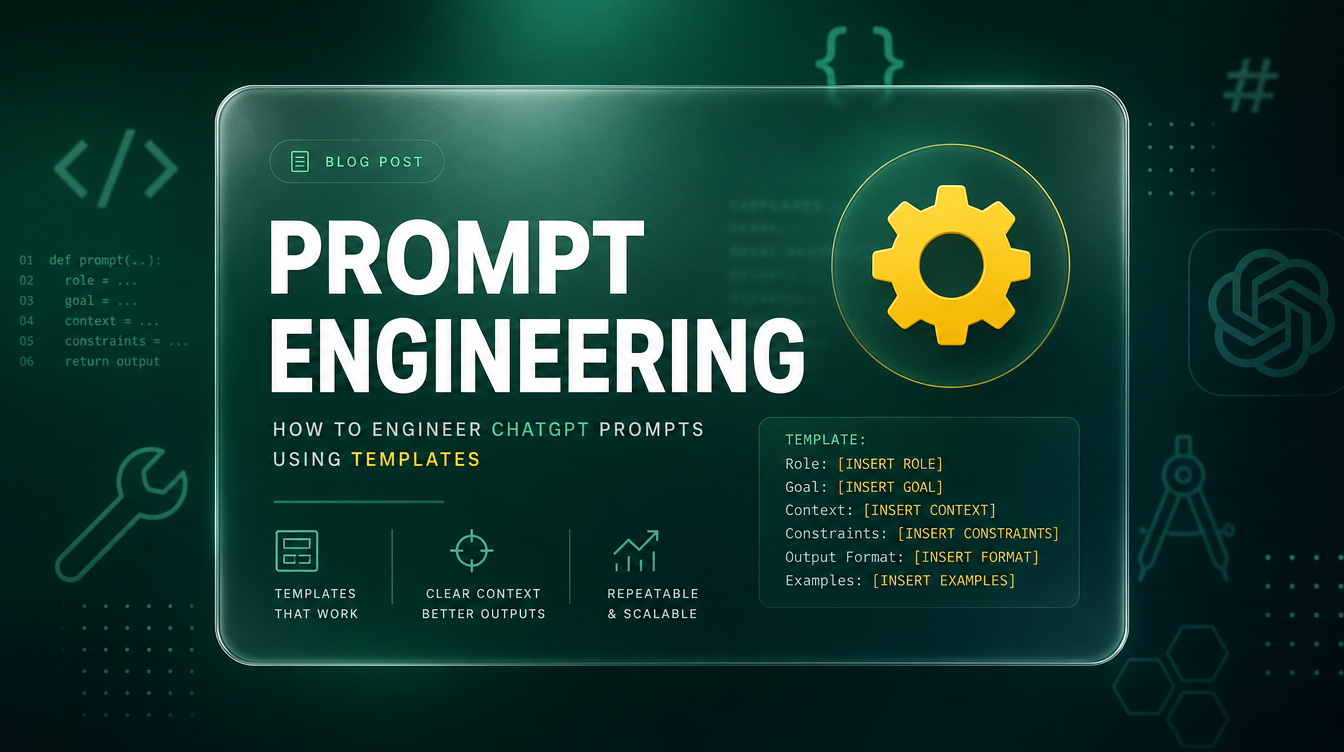
After a lot of trial and error, I've settled on four components that cover most prompt use cases. I call it the R.I.D.E. structure (role, intent, details, examples) and it's the frame I use for almost everything.
Role — who ChatGPT should be for this task. Not just a job title, but a specialized version: "a DTC copywriter who focuses on conversion-optimized landing pages for fashion brands" is more useful than "a copywriter." The role sets the model's vocabulary, assumptions, and output style before it writes a single word.
Intent — what you want produced, specifically. Include the format (list, paragraph, table), the length, and any structural requirements. "Write a product description" is intent. "Write a 130-word product description with a hook in the first sentence and a one-sentence CTA at the end" is better intent.
Details — the context the AI needs to make good decisions. Your audience. The tone. Key facts about the product or topic. Constraints that matter. This is where most prompts are underspecified, and where the biggest quality gains come from adding more.
Examples — optional, but powerful. Paste in a sample of output you like, a competitor's copy that works, or a short description of the style you're going for. Examples calibrate the model's output more precisely than adjectives alone. "Professional but warm, like Patagonia's brand copy" is more useful than "professional but warm."
That structure applied to a real task: "Act as a B2B SaaS copywriter focused on product-led growth. Write a 200-word feature page section for a time-tracking tool. Context: targeting engineering team leads at 50-200 person startups who are evaluating tools to reduce meeting overhead. Tone: direct and data-driven. Example of style: 'Jira's product page for Atlassian teams.'"
That prompt would produce something specific and usable on the first pass.
Templates by Use Case
Here are prompt templates I use across different types of work. Each follows the R.I.D.E. structure with the components labeled.
Resume summary: "Act as a tech recruiter with 10 years of experience hiring for growth-stage companies. Write a 3-sentence resume summary for a backend developer with 5 years of experience in Node.js, PostgreSQL, and AWS. Context: targeting director-level engineering roles at Series B–C startups. Emphasize impact metrics and leadership."
Brand copy: "Act as a DTC brand copywriter. Develop a brand voice guide for a minimalist skincare brand targeting Gen Z women aged 22-28 who are skeptical of over-hyped beauty products. Include: voice adjectives, what to avoid, 3 example sentences showing the voice in action."
Ad creative: "Act as a performance creative director. Write 3 Facebook ad headline + description pairs for a plant-based protein powder targeting men 28-38 who are into crossfit. Each headline under 40 characters. Descriptions under 90 characters. Angle 1: energy/performance. Angle 2: clean ingredients. Angle 3: lifestyle fit."
That second template is the one I use most for clients. The "do not include" line at the end is worth the extra sentence — it prevents the most predictable output problems (excessive hedging, overly formal language, unnecessary caveats) without requiring you to explain why.
How to Iterate When the First Output Misses
Even well-structured prompts don't always land perfectly the first time. The key to fast iteration is diagnosing what specifically went wrong rather than rewriting the whole prompt.
Three refinement moves I use constantly:
Tone correction: "The tone is too formal. Rewrite this as if you're speaking directly to the person, not presenting to a board."
Length correction: "This is too long. Cut it to 100 words without losing the CTA."
Structural correction: "Lead with the benefit, not the product description. Restructure the opening two sentences."
Targeted refinements preserve what's working while fixing what's not. Rewriting the whole prompt from scratch is usually slower than three cycles of targeted revision.
Building a Prompt Library Over Time
The highest-leverage prompting habit I've developed is saving every prompt that produces a result I'm happy with. Three months in, I had a library of 25 templates covering the tasks I do most. I stopped prompting from scratch for those tasks entirely.
If you're building a library for the first time and don't want to start from zero, the collections at PromptPlaza are organized by task type — marketing, product copy, visual generation, SEO — so you can start with tested templates and customize from there.
Frequently Asked Questions
Does prompt engineering require technical knowledge?
No. It's a communication skill, not a programming skill. The core competency is being specific and structured in how you describe what you want. If you can write a clear project brief, you can write good prompts.
How do I handle a prompt that produces inconsistent outputs?
Inconsistency usually means the prompt is underspecified in a critical area. Run the same prompt three times and look for where the outputs diverge. That's where the ambiguity is. Add a specific instruction for that variable — and inconsistency usually resolves.
Should I use system prompts or custom instructions for recurring work?
Yes, if your platform supports them. Custom instructions let you set a persistent context — your brand, your typical audience, your preferred output style — so every conversation starts from a consistent baseline. It's essentially a standing role assignment that you don't have to restate every session.
Are longer prompts always better?
No. A prompt with 10 well-chosen words can outperform a paragraph of vague context. What matters is that the prompt covers role, intent, and the most relevant details. More words that add information helps. More words that repeat or hedge don't.